

Last updated: Jun 30, 2026
What is a credit utilization ratio? (And why it makes or breaks your score)
Written by Tilt Editorial Staff

Instant Answer
Your credit utilization ratio is the percentage of your available revolving credit that you’re currently using. The formula: total balances divided by total credit limits. Most scoring guidance says to keep utilization under 30%, with under 10% considered ideal for excellent scores.
Credit utilization is specific to revolving credit accounts, like credit cards and lines of credit. This guidance doesn’t apply to installment loans like car loans or mortgages. Your credit utilization is also measured in 2 key ways: per individual card and across all your cards combined. These figures update each billing cycle, when lenders report your balances to Equifax, Experian, and TransUnion, not in real time.
How is credit utilization calculated?
Credit utilization is calculated by dividing your balance by your credit limit, then multiplying by 100 to get a percentage. You can calculate it 2 ways, and both appear on your credit profile:
Per-card utilization: one card’s balance divided by that card’s limit
Overall utilization: your total balance across all cards divided by your total limit
For example, imagine you have 2 credit cards:
Balances and limits below are as of the statement closing date, with no other revolving accounts.
| Account | Balance | Limit | Calculation | Utilization |
|---|---|---|---|---|
| Card A | $500 | $2,000 | 500 ÷ 2,000 × 100 | 25% |
| Card B | $300 | $1,000 | 300 ÷ 1,000 × 100 | 30% |
| Combined | $800 | $3,000 | 800 ÷ 3,000 × 100 | 26.7% |
Utilization for Card A is at 25% and utilization for Card B is at 30%. Your overall utilization across both is 26.7%. Though your combined rate looks fine, Card B’s 30% per-card rate can actually pull on your score. Both numbers show up in your credit profile, so keeping an eye on each card individually, not just the total, is worth the extra step.
What counts as a good credit utilization ratio?
Under 30% is largely considered a good credit utilization ratio. It’s what FICO and most credit education sources point to as the general guideline. Under 10% is where you tend to see the strongest scores.
A 0% utilization (meaning no balance at all on an active card) isn’t necessarily a problem. But if a card sits completely dormant, some lenders may eventually close it for inactivity. This would reduce your available credit and could impact the overall age of your credit accounts.
The 30% figure is a guideline, not a hard rule, though lower is generally better. And no single ratio guarantees a specific score — utilization works alongside payment history, account age, and several other factors.
What counts as a high credit utilization ratio?
Utilization above 30% is where most scoring guidance flags concern. If utilization reaches above 50% or 75%, the effect on your score can be more significant.
When utilization runs high, it signals to lenders that you may be stretched financially or relying on credit to cover regular expenses. That perception affects how creditors assess new applications.
Credit utilization falls within the Amounts Owed category of the FICO scoring model, which accounts for 30% of your FICO Score. This is second only to payment history at 35%, according to FICO. It’s the single largest factor outside of whether you pay on time.
Why does credit utilization affect your credit score?
The FICO Score model weights 5 categories. Payment history is the largest at 35%. Amounts Owed — which is primarily driven by credit utilization — is 30%.
Low utilization tells lenders you’re not leaning hard on your credit lines. High utilization suggests the opposite. That signal carries real weight in how both FICO Score and VantageScore calculate your creditworthiness.
VantageScore also incorporates utilization prominently, using similar logic: the percentage of available credit you’re using is treated as a meaningful indicator of financial health. Both major scoring models land in roughly the same place on this.
How do I lower my credit utilization ratio?
There are a few practical levers to lower your credit utilization ratio:
- Pay before your statement closing date: Lenders typically report your balance to the credit bureaus at the end of each billing cycle. If you pay down your balance before that date, the lower balance is what gets reported, not your balance at the payment due date.
- Make smaller payments more often: If you make purchases throughout the month, paying down the balance midcycle rather than waiting for the due date may keep your reported balance lower.
- Request a credit limit increase: If your spending stays the same but your limit goes up, your ratio drops. Many card issuers allow limit increase requests after a period of on-time payments.
- Open a new credit card: Adding a new card increases your total available credit, which can lower your overall utilization if your balances don’t change. It is worth noting that opening a new account triggers a hard inquiry, which may temporarily affect your score. The utilization benefit can outweigh the short-term inquiry impact for many people.
Consider if any of these options make sense for you based on your credit situation. If building credit is the goal, see how to lower it through everyday card habits, too.
How does opening a new credit card affect your utilization?
When you open a new card, your total available credit goes up. If your balances stay the same, your overall utilization ratio goes down.
Say you currently carry $800 across $3,000 in available credit — that’s 26.7% utilization. If you open a new card with a $1,500 limit (raising your total limit to $4,500) and add nothing to your balance, your utilization drops to about 17.8% ($800 ÷ $4,500 × 100).
The effect is real, but it depends on not increasing your spending to fill the new limit. A hard inquiry from the application may cause a small, temporary score dip, though it’s typically a minor factor compared to the utilization improvement over time.
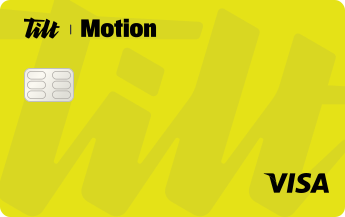
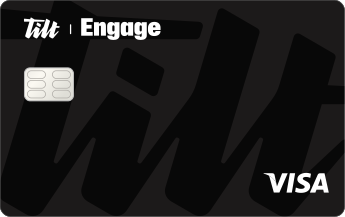
If you’re considering adding a card to help manage your utilization or start building credit history, the Tilt Engage Visa Credit Card and Tilt Motion Visa Credit Card, issued by WebBank, are built for people at this point in their credit journey. Both report to the major credit bureaus (Equifax, Experian, and TransUnion), require no security deposit, and you can pre-qualify without a credit score impact. Tilt Engage has a $59 annual fee with 1%–10% cash back at select merchants. Tilt Motion has no annual fee, also with 1%–10% cash back at select merchants. Terms apply.1
Frequently asked questions
How quickly does credit utilization affect your credit score?
Credit utilization can shift your score relatively quickly because it’s recalculated each time your lenders report your balance to the credit bureaus, which typically happens at the end of each billing cycle. Pay down a significant balance before your statement closing date, and you may see the change reflected in your score within 1 to 2 billing cycles. Exact timing varies by lender reporting schedule. See how utilization fits into your credit timeline at each stage of building credit.
Should I pay off my credit card every month to keep utilization low?
Paying your full balance each month is one of the most effective ways to keep utilization low. Because lenders often report your balance at the statement closing date rather than the payment due date, paying before closing may result in a lower reported balance. If paying in full isn’t possible right now, paying down as much as you can may still reduce your utilization and support your credit profile over time.
Does closing a credit card hurt your utilization?
Closing a card removes that card’s limit from your total available credit, which can raise your overall utilization ratio if your balances stay the same. For example: $500 in balances across $2,000 in total credit is 25% utilization. Close a card with a $500 limit, and the same $500 balance against $1,500 in available credit becomes 33.3%. If you’re actively building credit, keeping accounts open is generally worth considering.
Does a balance transfer affect my credit utilization?
A balance transfer moves debt from one card to another, so your overall utilization across all cards stays the same, unless the receiving card has a different limit. If the card you’re transferring to has a lower limit, that card’s individual utilization may climb even though your total balance hasn’t changed. Both per-card and overall utilization factor into your score, so it’s worth checking both before transferring.
Is credit utilization the same as credit card debt?
Not exactly. Credit card debt is the dollar amount you owe. Credit utilization is that amount expressed as a percentage of your total available credit. 2 people can carry the same balance but have very different utilization ratios. A $500 balance on a $1,000 limit is 50% utilization; the same $500 on a $5,000 limit is 10%. The ratio, not the raw dollar amount, is what the scoring models see.
Ready to put your credit to work?
If you’re looking for a card that works with where you are right now, the Tilt Engage Visa Credit Card and Tilt Motion Visa Credit Card, issued by WebBank, are built for people building or rebuilding credit. Both cards report to all 3 major credit bureaus, require no security deposit, and come with a pre-qualification check that won’t affect your score.
Tilt Disclosures: This content was created by Tilt and reflects Tilt’s opinions. Information was obtained from: https://www.myfico.com/credit-education/whats-in-your-credit-score as of June 2026; https://www.experian.com/blogs/ask-experian/credit-education/score-basics/credit-utilization-rate/ as of June 2026; https://www.experian.com/blogs/ask-experian/does-credit-utilization-matter-if-you-pay-in-full/ as of June 2026; https://www.experian.com/blogs/ask-experian/is-no-credit-utilization-good-for-credit-scores/ as of June 2026; https://vantagescore.com/resources/faqs as of June 2026; https://www.consumerfinance.gov/ask-cfpb/how-do-i-get-and-keep-a-good-credit-score-en-318/ as of June 2026.